The Moment Operators Start Asking the Wrong Question
Almost every casino reaches a point where the same concern starts circulating internally: “Traffic quality is getting worse.”
At first, it sounds like a media problem. Affiliates are blamed. PPC is questioned. SEO traffic is re-evaluated. Budgets get reshuffled.
But in most cases, the same pattern returns. Traffic quality appears to decline again, even when sources stay the same.
This is not a traffic problem. It’s a system problem.
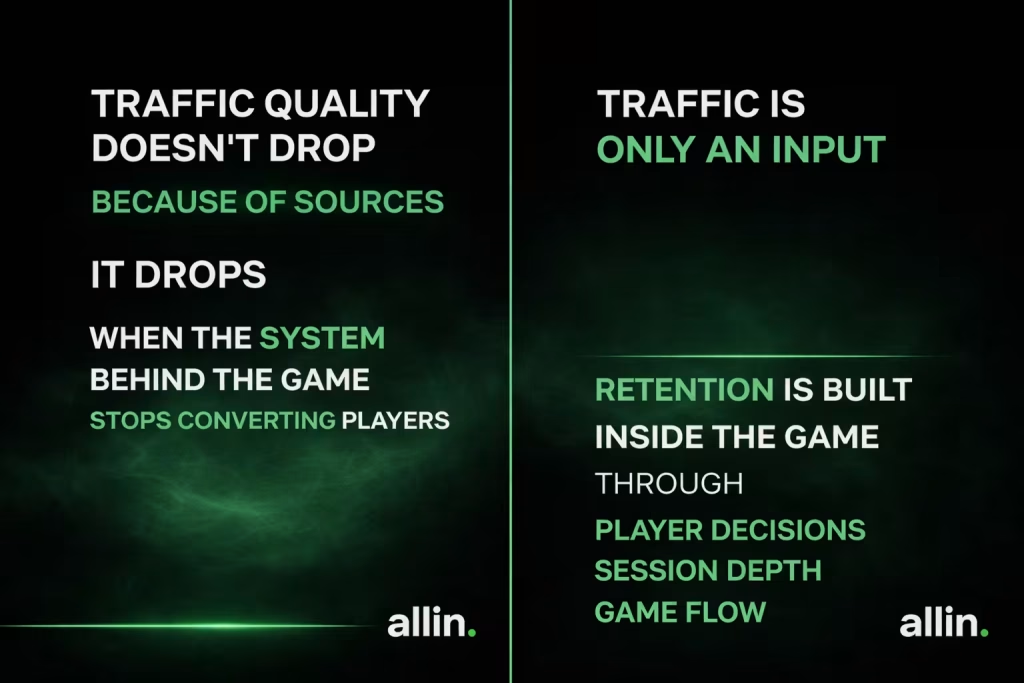
Traffic Quality Is a Symptom, Not a Root Cause
Traffic quality is not a fixed property of users. It is the result of how acquisition intent, product experience, and retention mechanics interact.
When this relationship breaks, traffic feels worse — even if the users themselves haven’t changed.
Operators often mistake declining engagement for bad traffic, when in reality the experience no longer matches player expectations.
Why Traffic Quality Almost Always Declines Over Time
Traffic quality erodes gradually through structural misalignment. As casinos grow, they attract broader player segments with different expectations.
If the product experience remains static, engagement naturally drops.
This is especially visible in slot-heavy environments, where early excitement fades quickly if the game mix, volatility profile, or feature mechanics don’t support long-term play.
Understanding which slot mechanics actually keep players engaged over multiple sessions is critical. Our breakdown of the best online slots to play in 2026 shows how certain mechanics outperform others when it comes to sustained engagement:
https://www.allinigaming.com/allinigaminghub/slots/slots-best-online-slots-to-play-in-2026/
Why Filtering Traffic Rarely Fixes the Problem
When traffic quality drops, the instinct is to filter harder — remove affiliates, tighten targeting, or block GEOs.
While this can temporarily stabilize metrics, it does not fix the underlying issue.
If a casino must constantly narrow traffic to remain profitable, the system underneath is too fragile.
Bonuses, Features, and the Illusion of Value
Many operators attempt to compensate for declining engagement by increasing bonus value or pushing aggressive feature mechanics.
However, not all incentives create equal value. In some cases, they accelerate churn by attracting short-term behavior.
A clear example is the difference between free spins and bonus buys. Each drives very different player behavior, and misunderstanding this can distort traffic quality metrics over time.
Read more here:
https://www.allinigaming.com/allinigaminghub/slots/slots-free-spins-vs-bonus-buys-value-guide-2026/
Market-Specific Expectations Matter
Traffic quality issues become even more pronounced in fast-growing markets like India.
Players in these regions often display different volatility tolerance, session patterns, and slot preferences.
Operators who apply a one-size-fits-all acquisition or product strategy see engagement decline faster — not because traffic is worse, but because expectations are misaligned.
Our analysis of the most played online slots in India highlights how local preferences directly impact retention:
https://www.allinigaming.com/allinigaminghub/slots/top-10-most-played-online-slots-india-2026-outlook/
What Actually Fixes Traffic Quality Over Time
Improving traffic quality is not about chasing better users. It’s about building a system that converts a wider range of users into long-term value.
This requires:
• Product-first retention design
• Acquisition promises that match real gameplay
• Game selection aligned with player intent
• Early-session engagement that reduces dependency on bonuses
A Final Perspective for Operators
If your casino feels like it attracts worse traffic than before, pause before switching channels or cutting partners.
Ask whether the system has evolved to meet the audience you’re attracting today.
Traffic doesn’t decay.
Systems do.
—
Soft CTA:
If traffic quality keeps dropping, the issue isn’t volume — it’s alignment. We help operators fix the system before they buy more traffic.